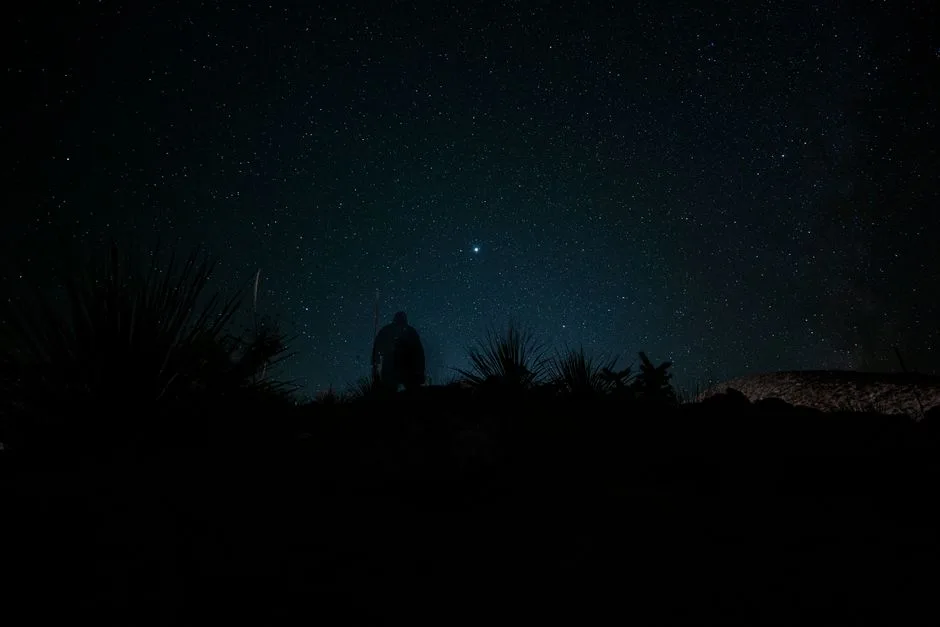
A guy I hauled freight with for a few months used to talk about aliens every single shift. Ancient astronauts, government cover-ups, all of it. One night outside Flagstaff, staring up at more stars than either of us had ever seen from a city, he asked me straight out: "Etheridge, you're a believer, what does the Bible say about aliens?" I didn't have a slick answer. I still don't, fully. But I've thought about that question a lot since, and I want to walk through it honestly instead of pretending Scripture says more than it does.
If you've typed this question into a search bar, you're probably not looking for a sci-fi theory. You're looking for something solid to stand on. Let's look at what the Bible actually addresses, and just as importantly, what it doesn't.
✝ Try FaithSpark Free
AI-powered daily devotionals, a prayer journal, and Bible reader, built by a truck driver who needed something real for the road.
What Does the Bible Actually Say About Aliens? The Short Answer
The Bible never directly mentions extraterrestrial life, it simply isn't a question Scripture was written to answer, since its focus is God's relationship with humanity on this earth.
I want to be straight with you here: there is no verse that says "aliens exist" or "aliens don't exist." Genesis 1 tells us God created the heavens and the earth, and that's about as far as the text goes regarding what's "out there." The Bible is a book about God's redemptive relationship with humanity, not a cosmological survey of the universe.
That doesn't mean the question is dumb to ask. It means we have to be honest about category, this is a question Scripture leaves open, not one it closes either way.
Does Genesis Rule Out Life Beyond Earth?
Genesis doesn't explicitly rule out or confirm other life in the universe, its focus is the creation of humanity in God's image on this particular earth, not an inventory of everything that may exist elsewhere.
Genesis 1:1 says, "In the beginning God created the heavens and the earth." Some people read "the heavens" as evidence the universe is vast and full of unknowns, possibly including other life. Others point to Genesis 1:27, humanity made "in the image of God", as evidence that humans hold a unique, unrepeated role in creation, which would seem to leave less room for other "image bearers" elsewhere.
Both readings are honestly defensible, and good, faithful Christians land on different sides. I don't think this is a hill worth dying on. What I do think matters is that whatever else exists, God made it, and God is sovereign over it.
The Nephilim and "Sons of God": Are They Aliens?
The Nephilim in Genesis 6 are sometimes connected to ancient-astronaut theories, but most biblical scholars read "sons of God" as referring to fallen angelic beings or powerful human rulers, not extraterrestrials.
This is the passage that gets dragged into alien conversations more than any other. Genesis 6:4 says, "The Nephilim were on the earth in those days, and also afterward, when the sons of God went to the daughters of humans and had children with them." It's a strange, compressed passage, and honestly, even serious theologians disagree about exactly what it means.
What I can tell you is that the most common scholarly interpretations point to either fallen angels (similar to what's described in Jude 1:6) or powerful human dynasties intermarrying, not visitors from another planet. The "ancient astronaut" reading is a modern theory laid on top of an ancient text, not something the original audience would have understood that way.
I don't think you need to have this one fully figured out. It's one of the genuinely mysterious corners of Scripture, and it's okay to hold it with open hands.
Why This Question Matters More Than You'd Think
This question matters because it tests whether your faith is built on curiosity about the unknown or on the character of a God who is trustworthy regardless of what's still unanswered.
Here's what I noticed talking with that guy at the truck stop: underneath the alien talk was a real question about whether the universe is random or whether someone is actually in charge of it. That's not a silly question. That's the question.
Whatever exists out past our solar system, Scripture is clear that God made it and rules over it. Colossians 1:16 says, "For in him all things were created: things in heaven and on earth, visible and invisible." That includes whatever we haven't discovered yet. You don't need a complete map of the universe to trust the One who drew it.
How to Think About Aliens Without Losing Your Faith
You can hold curiosity about the unexplained with an open hand, while keeping your confidence anchored in what Scripture clearly does teach rather than in speculation about what it doesn't address.
If you're someone who genuinely wonders about this stuff, and plenty of thoughtful believers do, here's how I've learned to hold it: stay curious, stay humble, and don't let speculation about the unexplained become the foundation your faith stands on. Foundations get built on what's clear: who Jesus is, what He did, and what He promised. Everything else is downstream from that.
2 Timothy 1:7 says God has not given us a spirit of fear. Whatever is or isn't out there, you don't have to approach it from anxiety. You can approach it from a settled trust that nothing in creation is bigger than its Creator.
What Actually Matters More Than the Answer
What matters more than solving the alien question is whether you know the God who made everything that exists, seen or unseen, that relationship doesn't depend on resolving this mystery.
I never did give that guy outside Flagstaff a tidy answer, because I don't have one. What I told him instead was this: I don't know what else God made out there, but I know the God who made it, and that's enough for me to sleep at night under all those stars. If you're wrestling with this question, I'd encourage you to hold it the same way, curious, unafraid, and rooted in the God who is bigger than every mystery you haven't solved yet.