The fastest way to start studying the Bible as a beginner is the SOAP method: read a short passage slowly, write down what you observe about it, note one honest way it applies to your life, then pray through what you found. That four step pattern, Scripture, Observation, Application, Prayer, takes fifteen to twenty minutes and works with any passage, any day.
That's the short version. The rest of this guide covers how to go deeper, how to study an entire book instead of isolated verses, which free tools and study Bibles actually help, and the three questions every serious Bible study eventually has to answer.
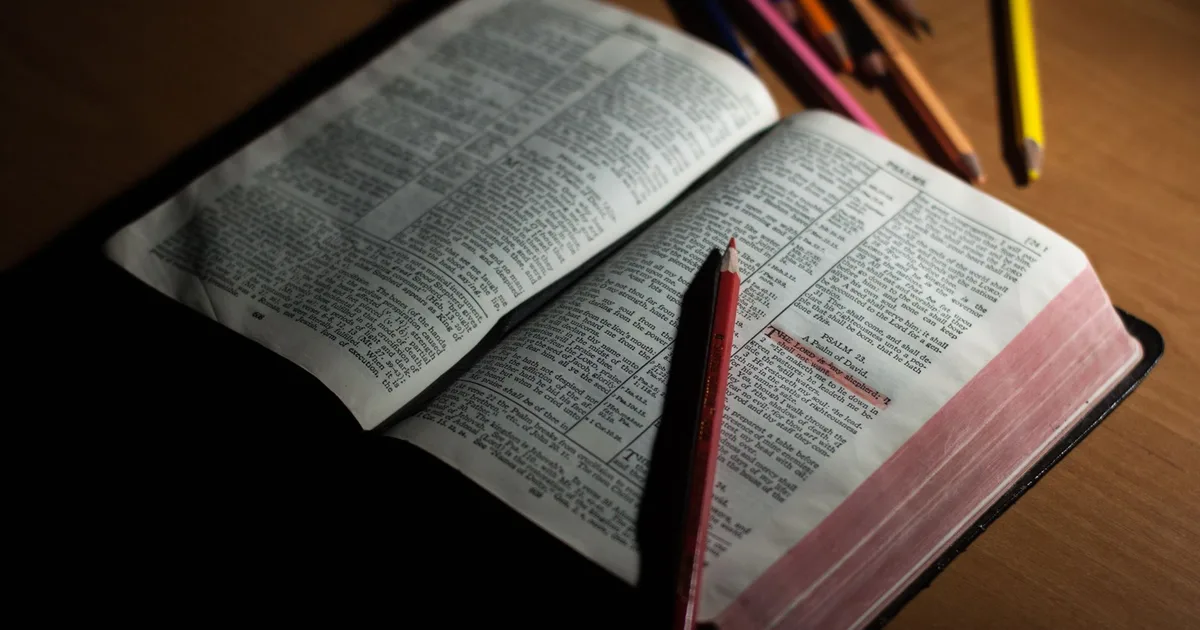
Reading the Bible and studying the Bible are related but different activities, and both matter. Reading is taking in the narrative, the story and theology and poetry and prophecy of Scripture at a pace that lets you see the whole. Studying is slowing down to ask what a word actually meant in its original language, what was happening historically when it was written, and what the original audience understood that a modern reader might be missing.
✝ Try FaithSpark Free
FaithSpark's Bible reader, Bible courses, and reading plans are free at mindgardenpress.com, with everything you need to read and study Scripture.
The Three Questions Every Bible Study Should Answer
No matter what method you use, every Bible study session should work toward answering three questions about the passage you are reading:
What did it mean? What did this passage mean to the people who first read or heard it? What was the historical situation? What did the key words mean in their original language? This is the interpretation question.
What does it mean? What does this passage teach about God, humanity, sin, redemption, or the Christian life that is timelessly true regardless of cultural context? This is the theological question.
What does it mean for me? How does the timeless meaning of this passage apply specifically to your life right now? What should you believe differently, do differently, or pray about based on what you have found? This is the application question.
Every legitimate Bible study method is essentially a systematic way of answering these three questions.
The SOAP Method for Bible Study
The SOAP method is one of the simplest and most effective Bible study frameworks for beginners. It stands for Scripture, Observation, Application, Prayer.
Scripture. Read the passage. Write out the verse or verses that stand out most to you.
Observation. What do you notice about the passage? Who is writing? Who are they writing to? What is happening before and after this passage? What words or phrases repeat? What surprises you?
Application. How does this passage apply to your life right now? Be specific. "Trust God more" is not an application. "This week, when I am tempted to worry about the interview on Thursday, I will read Philippians 4:6 and bring it to God specifically" is an application.
Prayer. Pray through what you have found. Pray for understanding, for the ability to apply what you have seen, and for the people in your life who need what this passage addresses.
SOAP takes fifteen to twenty minutes per passage and can be used with any Scripture, any day. It is a strong foundation for a beginner Bible study practice.

How to Study a Book of the Bible: A Beginner's Approach
Studying an entire book of the Bible produces more theological depth than studying isolated verses, because books have argument structures that only become clear when you read the whole thing.
Step 1: Read the book once through without stopping. Get the whole narrative or argument in your mind before you study any single part of it.
Step 2: Read the book a second time and note the major themes. What topics keep coming up? What is the author's apparent purpose? What seems to be the main argument or narrative thread?
Step 3: Study chapter by chapter. For each chapter, use the three questions above: what did it mean, what does it mean, what does it mean for me?
Step 4: Read a commentary or study guide. After you have done your own observation, check your conclusions against someone who has done deep research into the original context. You will be surprised how often you caught something important, and surprised by what you missed.
Step 5: Journal your findings. What changed in how you see this book? What did you learn about God that you did not know before? What specific application are you taking into your life?
Free Tools for Bible Study
You do not need expensive resources to study the Bible well. Here are the free tools that provide the most value:
Blue Letter Bible (blueletterbible.org). Free access to original language lexicons, commentaries, and cross-references. When you want to know what a Greek or Hebrew word actually means, this is the first place to go.
Bible Hub (biblehub.com). Parallel translations, interlinear text, and free commentaries from multiple scholars. The parallel view lets you compare how different translations render the same verse.
The FaithSpark Bible reader. The FaithSpark Bible reader at mindgardenpress.com includes the full KJV Bible with bookmarking and verse lookup. Free in your browser.
YouTube. The BibleProject channel has free animated videos that explain the structure, themes, and theology of every book in the Bible. These are extraordinary resources for building the contextual understanding that makes individual passages make sense.

The Best Study Bible for Beginners
A study Bible is a Bible with explanatory notes, cross-references, maps, and introductions to each book built directly into the margin. For beginners, a good study Bible dramatically accelerates understanding by providing context you would otherwise need years to acquire independently.
The NIV Study Bible and the ESV Study Bible are both excellent for beginners. The NIV is slightly more readable; the ESV notes are slightly more comprehensive. Both are available in print and through the YouVersion app.
The most important thing to remember about study Bible notes: they are human commentary, not Scripture. Read them after you have done your own observation of the text, not as a substitute for it.
Explore the free FaithSpark Bible reader and Bible courses at mindgardenpress.com/faithspark-app/ to support your Bible study practice.