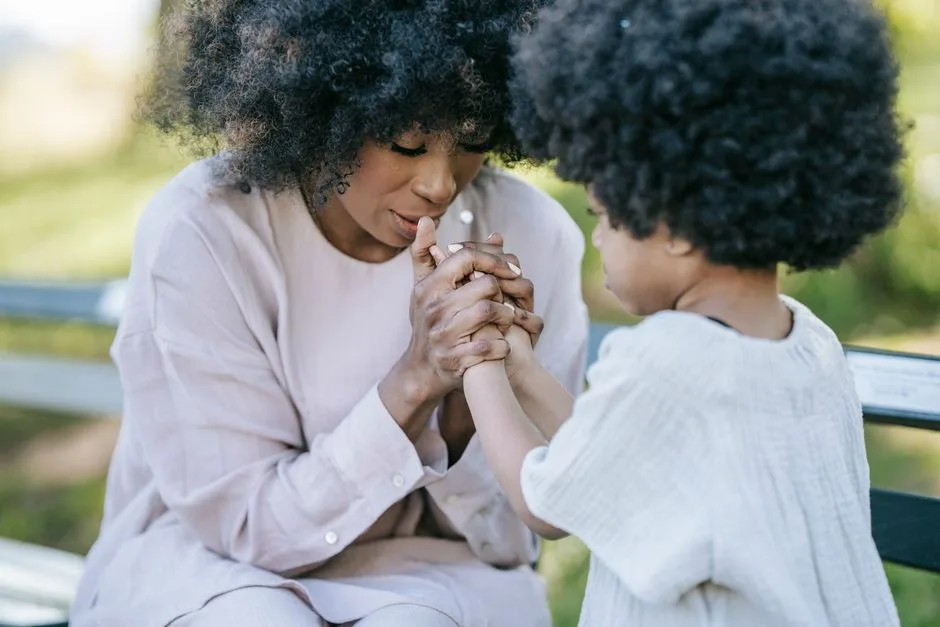
My mother prayed for me through years I wasn't easy to pray for. Long hauls, bad choices, seasons where I wasn't who I am now. I think about that a lot when I read what the Bible says about mothers, because Scripture doesn't talk about motherhood as a soft, sentimental greeting-card idea. It talks about it as real strength, real sacrifice, and a calling God takes seriously.
✝ Try FaithSpark Free
AI-powered daily devotionals, a prayer journal, and Bible reader, built by a truck driver who needed something real for the road.
What Does the Bible Say About a Mother? The Short Answer
The Bible honors mothers as a foundational, God-given role, commanding their children to respect them, and repeatedly portraying motherhood through real examples of strength, prayer, and sacrifice rather than a soft stereotype.
Exodus 20:12 puts honoring your mother right inside the Ten Commandments, alongside honoring your father. That placement alone tells you something about how seriously God takes this relationship. Scripture doesn't romanticize motherhood into something easy, it shows it as hard, costly, and deeply significant.
Honoring Your Mother: What Scripture Commands
Honoring your mother is commanded directly in the Ten Commandments and repeated by Paul in the New Testament, framed as a command that comes with a specific promise attached to it.
Exodus 20:12 says, "Honor your father and your mother, so that you may live long in the land the Lord your God is giving you." Ephesians 6:2-3 quotes this and calls it "the first commandment with a promise." That's not a small detail. Paul is pointing out that God specifically attached a blessing to this particular command.
Honor doesn't mean your mother was perfect, or that every memory is easy. It means giving the respect, care, and gratitude due to someone who carried real weight on your behalf, even imperfectly.

Hannah: A Picture of a Mother's Prayer and Sacrifice
Hannah's story in 1 Samuel shows a mother's desperate prayer for a child, followed by a sacrifice few parents could imagine, dedicating her long-awaited son Samuel to the Lord's service.
1 Samuel 1 describes Hannah weeping and praying for years for a child, promising God that if He gave her a son, she would dedicate him to the Lord. When Samuel was born and weaned, she kept that promise, bringing him to serve at the temple under Eli. 1 Samuel 2:19 says she visited him each year with a little robe she made him.
That's not a sanitized, easy picture of motherhood. That's a mother who prayed hard for a child and then gave him to a purpose bigger than her own comfort. Hannah's prayer in 1 Samuel 2 is one of the most powerful prayers in Scripture, and it came directly out of her experience as a mother.
What Proverbs 31 Really Says About a Godly Mother
Proverbs 31's description of a capable woman is an aspirational, poetic picture of wisdom and strength in motherhood and household management, not a literal daily checklist meant to produce guilt.
Proverbs 31:10-31 describes a woman who works with her hands, manages a household, invests wisely, cares for the poor, and speaks with wisdom. Verse 28 says, "Her children arise and call her blessed." It's a beautiful, demanding picture, and it's poetry, meant to honor and inspire, not a literal to-do list meant to make any real mother feel like she's failing by comparison.
If you're a mother reading this exhausted at the end of a hard day, Proverbs 31 isn't a measuring stick against you. It's a tribute to the kind of strength motherhood actually requires, written by someone who clearly respected it.

Motherhood Is Honored, But It Isn't a Woman's Only Calling
Scripture honors motherhood as a high and meaningful calling while also showing women in other significant roles, making clear that motherhood, though honored, isn't presented as a woman's only valid path.
It's worth saying plainly: the Bible elevates motherhood, but it doesn't reduce women to only that role. Deborah judged a nation. Lydia ran a business and hosted a church (Acts 16:14-15). Phoebe served as a deacon (Romans 16:1). Paul speaks respectfully of singleness and ministry without children in 1 Corinthians 7:8. Motherhood is honored deeply in Scripture, it's just not treated as the only honorable calling available to a woman.
A Word for Mothers Who Feel Like They're Not Enough
If you're a mother who feels like you're falling short, Scripture's picture of motherhood is one of grace and ongoing strength, not flawless performance. God sees the real, hard work, not just the polished moments.
If you're a mother reading this and feeling like you don't measure up to some picture in your head of what a "good mother" looks like, I want to say this clearly: God sees the 2 a.m. feedings, the prayers said through gritted teeth, the patience you didn't think you had left. Galatians 6:9 says don't grow weary in doing good, because a harvest is coming. Your work matters, even on the days it doesn't feel like it.