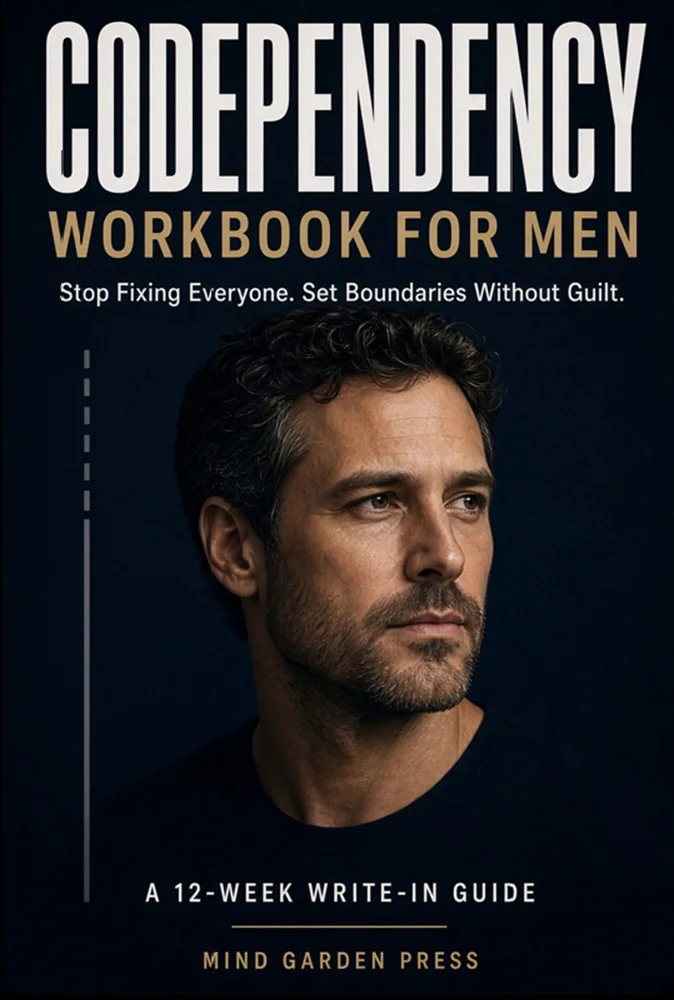
I know the guy this book is for. I've been him. The one who pays the bill that isn't his, covers the lie at work, stays up checking a phone that won't stop lighting up, and calls it love because it feels like strength. It isn't strength. It's two jobs, yours and someone else's, and you're the only one clocked in for both.
Codependency Workbook for Men is a 12-week write-in guide built for exactly that man. Not a lecture. Not a diagnosis. A workbook, meant to actually get written in.
📖 Codependency Workbook for Men
A 12-week write-in guide to stop fixing everyone, set boundaries without guilt, and take your life back.
Who This Book Is Actually For
You don't have to know the word codependency to need this book. You just have to recognize a few things:
- You're the reliable one, and you're worn out.
- You confuse love with management.
- Somebody else's mood, choices, or chaos runs your day more than you'd like to admit.
- You want a spine without becoming cold about it.
- You're doing this for you, not to change them.
If even one of those lands, the book already knows what it's talking to.
What's Actually Inside
Twelve weeks, one chapter each, plus a midpoint check and thirty extra days at the back for after you finish. Here's the full walk:
- Your Job and Not Your Job
- How You Learned This
- The Fixer Pattern
- Silence, Anger, and Shutdown
- Money, Time, and Covering
- Boundaries Without a Speech
- When Someone You Love Is in Chaos
- Resentment and the Scoreboard
- Work, Home, and the Same Pattern
- Repair Without Rescuing
- A Life That Is Yours
- Keep the Change
Every week runs the same shape: a short read, an honest checklist, one real situation you write out, a couple of scripts you can actually say out loud, a daily log, and an end-of-week check. Nothing fancy. Ink on the page, not another book you nod along to and put down unchanged.
Inside a Few Actual Weeks
Week 1: Your Job and Not Your Job
The book opens here on purpose, because everything else builds on this split.
A lot of men call this love. Paying the extra bill. Covering the lie. Driving across town at midnight. Staying in the fight long after the other person has stopped trying. You tell yourself a good man handles it.
That is not strength. That is you doing two jobs. Yours and theirs.
Then it gets specific: your job is your body, your money, your word, your kids when they're with you, and the next right action you can take today. Not your job is another adult's sobriety, mood, choices, reputation, or wake-up call. You can care. You cannot carry it.
Week 3: The Fixer Pattern
This is the one that stings for a lot of men, because fixing feels like usefulness, and usefulness feels like worth.
Fixing is not the same as helping. Help is asked for, limited, and leaves the other adult standing. Fixing takes over. Then you resent them for needing you.
The whole week runs on one pause question: did they ask, or did my fear start moving my hands?
Week 6: Boundaries Without a Speech
By week six the book stops explaining and starts drilling the actual sentence.
A boundary is a sentence plus a follow through. It is not a lecture, a threat, or a hope.
If you say it and then undo it, you taught them the sentence does not count.
The scripts in this week are short on purpose: No. I am not available for that. If you drink here, I will leave. Say it once. Don't explain it for ten minutes.
How to Actually Use It
The book is blunt about this up front: if you only read it, you will nod and stay the same.
- Do one week at a time. A week is seven days, not a mood.
- Write short. Facts beat speeches.
- Say one line out loud. Pick one script and actually use it once.
- If a week hits a live crisis, keep the one move small. Safety first, then come back to the page.
- You can do this alone, or take a page to a counselor, a pastor, a sponsor, or a trusted man who won't help you lie to yourself.
And when you slip, and you will, every single week has a built-in reset page for exactly that. A slip is data. It's not proof the book failed.
📖 Get the Full 12 Weeks
Twelve weeks, real scripts, a midpoint check, and 30 more days to keep the change after you finish.
A Word for the Man Reading This
The book ends its own introduction with a line worth repeating here: it will not make another adult get sober, get kind, or get honest. It will not replace a doctor, a lawyer, or a safety plan. It will not turn you into a man who never gets angry. It will help you stop using anger, silence, and overwork as your only tools.
That's the whole deal. Not a finished man in twelve weeks. A man who notices sooner and gets back to his own lane faster.
If you want to go deeper on any one piece of this before you commit to the full twelve weeks, we've written a few standalone guides that walk through specific parts of the pattern: the real difference between codependency and interdependency, how to tell if you're enabling someone instead of helping them, and what codependency looks like when the chaos is addiction.